
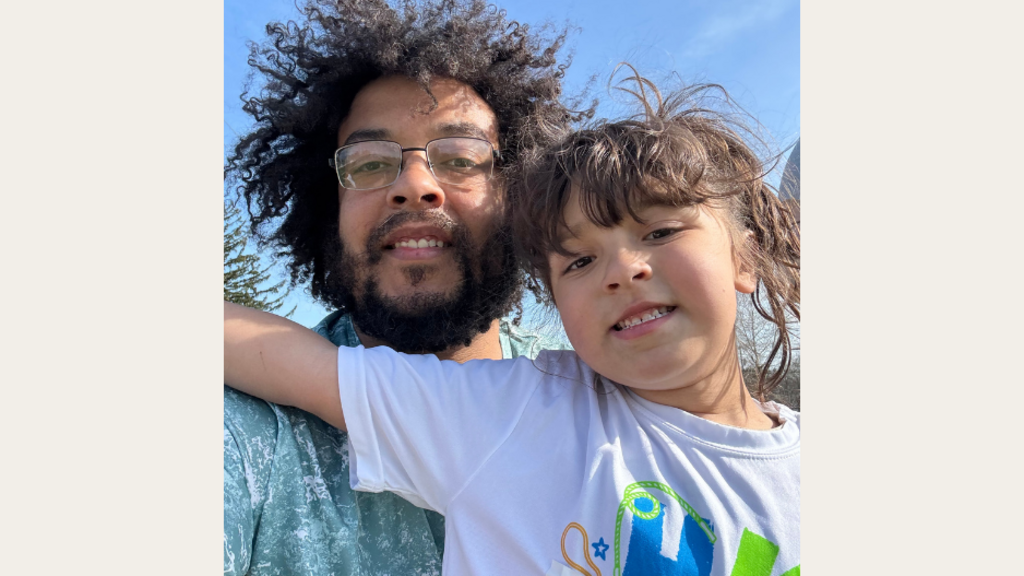
Photo by Jason Tavares
Adventures are rarely linear, and for Jason Tavares, that is exactly what makes his journey so powerful.
Jason Tavares is a doctoral student in the education program with a concentration in applied linguistics at Temple University’s College of Education and Human Development (CEHD). He began his studies in the 2023–2024 academic year and is currently enrolled part-time while working full-time as a German teacher in Chester County. Outside the classroom, he is a devoted husband and father, balancing family life, teaching and doctoral studies.
“I always knew I wanted to earn my doctorate,” Tavares said. “It just did not happen the way I expected.”
After graduating from college, Tavares planned to move directly into a PhD program. But during his senior year, the sudden loss of his father changed everything. In the wake of that loss, he stepped into a new role at home, prioritizing family support over academic ambition.
“It was not where I saw myself,” he said, “but it was what I had to do.”
To help support his family, Tavares entered the workforce, taking a job in telemarketing. The work was far removed from the academic path he had envisioned, but it became a necessary chapter in his story.
Everything shifted again when an unexpected opportunity arrived. His former high school German teacher reached out and asked if he would consider taking over her classroom.
That moment became a turning point.
“I said yes, went back to school for my master’s and never looked back,” he shared.
Tavares’s connection to language learning began years earlier, during a high school exchange program in Germany. Immersed in a new culture and forced to navigate daily life in another language, he quickly realized the difference between classroom learning and real-world communication.
“I remember thinking, this is real now,” he said. “I was not as confident as I wanted to be.”
That experience stayed with him and eventually shaped the direction of his doctoral research. Today, his work in applied linguistics focuses on improving how foreign languages are taught in the United States, with an emphasis on preparing students for authentic communication beyond the classroom.
“I want students to feel prepared and confident using a language, not just in class, but in real life,” he noted.
Tavares’s transition into doctoral life came with uncertainty. At Temple, that feeling slowly began to shift.
“In my first class, I had a feeling that I did not belong,” he said. “But that changed quickly. The support here made me realize that I did.”
That sense of belonging deepened when he was named a Holmes Scholar. The recognition has provided opportunities to engage in research, expand his professional network and connect with other scholars committed to advancing equity in education.
For Tavares, the significance of the program extends beyond professional development. It is also about visibility in the classroom and in academia.
“I never had a teacher who looked like me growing up,” he said. “Being part of the Holmes Scholars Program, which promotes representation, matters. I want students who look like me to see what is possible for themselves.”
For him, success is not measured by grades or titles, but by moments of growth and confidence in his students.
“The best moments are when students come back and tell me they did better than they expected,” he shared. “It shows them they were capable all along.”
Across different educational settings, Tavares has built a teaching philosophy rooted in inclusion, encouragement and belief in student potential. He strives to ensure that every learner feels seen and supported.
At the center of his journey are his wife and daughter, who remain his strongest sources of motivation.
“My daughter is the reason I started this journey and the reason I keep going,” he said. “I want her to see what is possible.”
As a first-generation college graduate, he carries that sense of possibility into both his teaching and research, hoping his path shows that perseverance can open doors that once felt out of reach.
Looking ahead, he hopes to transition into higher education, bringing his experience as both a classroom teacher and researcher into the college classroom. While his path continues to evolve, his focus remains steady: making language learning more accessible, meaningful and lasting.