
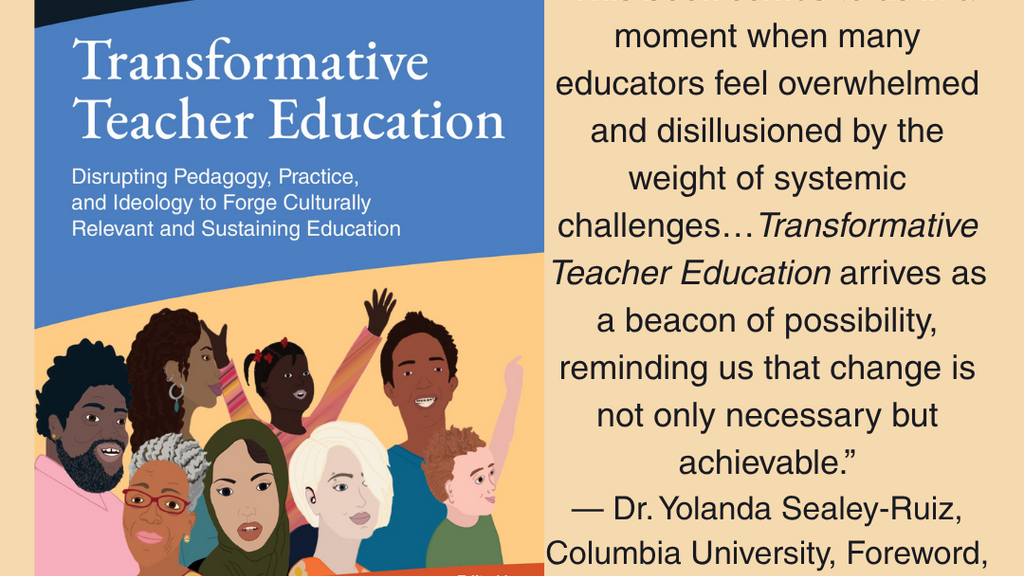
A new book co-edited by Temple University College of Education and Human Development (CEHD) leaders highlights how educators across Pennsylvania are working to make culturally relevant and sustaining education a meaningful part of teacher preparation.
Transformative Teacher Education: Disrupting Pedagogy, Practice, and Ideology to Forge Culturally Relevant and Sustaining Education (CRSE) is co-edited by Juliet Curci, assistant dean of college access and persistence and executive director of the Center for Reimagining Excellence, Access and Transforming in Education (CREATE), and Luca Poxon, education support professional and former CRSE project coordinator with CREATE. They collaborated with Donna-Marie Cole, a longtime colleague, assistant professor at East Stroudsburg University and co-executive director of the Pennsylvania Educator Diversity Consortium.
The book developed in response to changes to Pennsylvania’s expectations for teacher preparation. In 2022, as the state introduced new culturally relevant and responsive education competencies, many teacher educators were working through what those expectations would look like in practice. With the support of a grant from the William Penn Foundation to Temple, Curci and colleagues created and facilitated a community of practice in which educators could meet regularly, discuss the new competencies and consider how they could be incorporated into teacher preparation programs. Over time, those conversations developed into revised course syllabi and written reflections that ultimately became the foundation for the content shared in the book.
Curci shares, “The work of the community of practice participants was meaningful and significant. It became evident that sharing about their efforts, the successes and the challenges, could inspire and provide examples for others’ engagement with culturally relevant and sustaining education.”
While there is already significant scholarship surrounding culturally responsive education, Poxon said one of the goals of the project was to address the gap between scholarship and implementation. Contributors share the practical changes they made within their own programs, including revising syllabi, reconsidering parts of teacher preparation and reflecting their own growth as educators.
That reflection is an important part of what makes the work, as described in the book, transformative. It not only focuses on changing systems or institutions but also pushes educators to examine their own practice and consider how they can grow. Equity, collaboration and commitment are central themes throughout the book.
The text brings together the experiences of more than 20 educators and is especially relevant for those who prepare future teachers. Contributors discuss challenges that can come with identity-based work, institutional resistance and the broader sociopolitical environment, while also showing the value of having a community where educators can openly discuss why this work matters.
Poxon wants readers to understand that educators do not need to have everything figured out before they begin. He hopes readers can see that there is a place to start, regardless of where they are on their own journey, and understand that they do not have to navigate the work alone.
The project also reflects CEHD’s commitment to equity in education and community partnership. It exemplifies the work happening through CREATE, which focuses on expanding and advancing educational opportunities for young people, their families and educators. Through this initiative, educators were able to connect across institutions, reflect on their experiences and turn those experiences into a resource that can now reach a broader community.