
Photo courtesy of Tim Patterson
This summer, College of Education and Human Development (CEHD) Associate Professor Tim Patterson took his work on classroom discussions from Philadelphia to Singapore, where he spent two weeks as the Singaporean Ministry of Education’s 2026 Outstanding Educator-in-Consultancy. The invitation grew out of Patterson’s six-year DISCUSS Philadelphia project, which examines how early-career social studies teachers develop their identities as facilitators of classroom discussions. At the heart of the project is the belief that young people in a pluralistic, deliberative democracy need opportunities to “engage and make decisions together,” Patterson explained.
Patterson’s summer role was a critical component of an important goal within Singapore’s revised Character and Citizenship Education (CCE) framework. In traditional Singaporean classrooms, “the teacher talks, the students receive,” Patterson explained. But the Ministry of Education recognized that this classroom practice was not enough to prepare students to participate in a multicultural democracy like that of Singapore.
Their revised framework mandates more student-to-student discourse. Patterson’s expertise was sought to encourage teachers in all subjects to play a role in developing students’ character and citizenship.
“The idea is that every teacher in Singapore, regardless of what subject they teach, should see themselves as a character and citizenship teacher,” Patterson said. The broader goal, he explained, is to help students learn how to “negotiate differences” in a country that is multicultural, multilingual and multiethnic.
Patterson began laying the foundation for his visit in April, when he shared different approaches to classroom discussion with Singaporean educators as the keynote speaker at Singapore’s 2026 Character and Citizenship Education Learning Day.
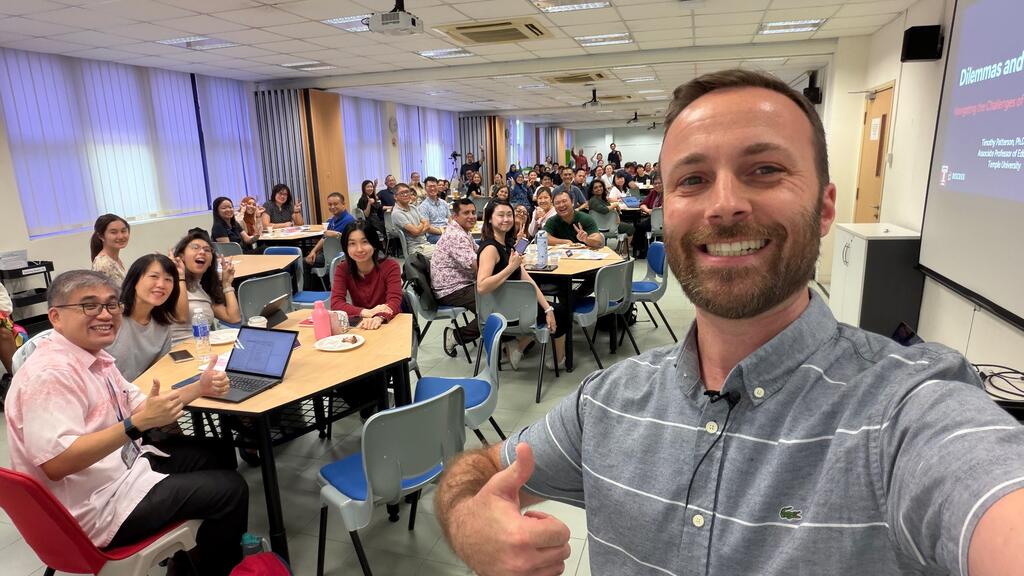
During his visit in August, Patterson stepped into Singaporean classrooms, working alongside primary and secondary school teachers as they explored ways to give students a greater role in classroom discussions. He visited two primary schools and one secondary school, observing teachers as they attempted to facilitate classroom discussions. He also taught one lesson on citizenship in a secondary classroom, demonstrating various discussion techniques.
Patterson’s ability to connect with educators was aided by a shared point of reference. “Singaporean teachers were already familiar with the Dynamic Systems Model of Role Identity (DSMRI),” a framework developed by CEHD faculty member Avi Kaplan. The DSMRI is also the framework that guides the DISCUSS Philadelphia project.
This common ground allowed Patterson to work closely alongside teachers as they explored ways to give students a greater role in discussions. In one primary classroom, for instance, he observed a lesson meant to feature a discussion but dominated by teacher-led talk. Seeing opportunities for students to engage with each other, Patterson said, “I intervened and began to co-teach the lesson with that teacher,” creating more opportunities for students to talk with one another.
Building on these classroom visits, Patterson led four three-hour professional development workshops for about 400 teachers, using video footage from the classroom visits to help teachers examine their own practice as discussion facilitators. Patterson understands that teachers want to leave a professional development session with specific strategies they can put into practice, whether that is a fishbowl, a Socratic seminar, or another structure for getting students talking. But for him, knowing the technique is only part of the work.
“A discussion can quickly move in a direction a teacher did not anticipate,” Patterson said, adding that knowing what to do next requires more than knowing the steps of a particular activity. At the workshops, the host teachers were invited to reflect with Patterson on dilemmas they faced during the lessons he observed. Rather than simply telling the host teachers what they could have done differently in the lessons he observed, Patterson used the classroom recordings to facilitate a dialogue about their emerging role identities.
While Patterson is back in Philadelphia, Singaporean teachers' reflections will continue in a follow-up webinar in October 2026.
Patterson sees his role as Outstanding Educator-in-Consultancy less as providing teachers with a formula, and more as helping them explore their identities as discussion facilitators.
“I think of myself as a critical friend,” he said. “I am trying to get them to think about who they are as teachers.”
The Singapore experience changed Patterson’s understanding of his own role as an educator working across cultures. He described feeling “humbled” by the opportunity and acknowledged that working in a different educational and cultural context required him to listen more carefully. While the experience challenged him professionally, there was one part of Singapore he said he would certainly miss: “some of the best food I’ve eaten on the planet… anywhere you went, just outstanding food.”
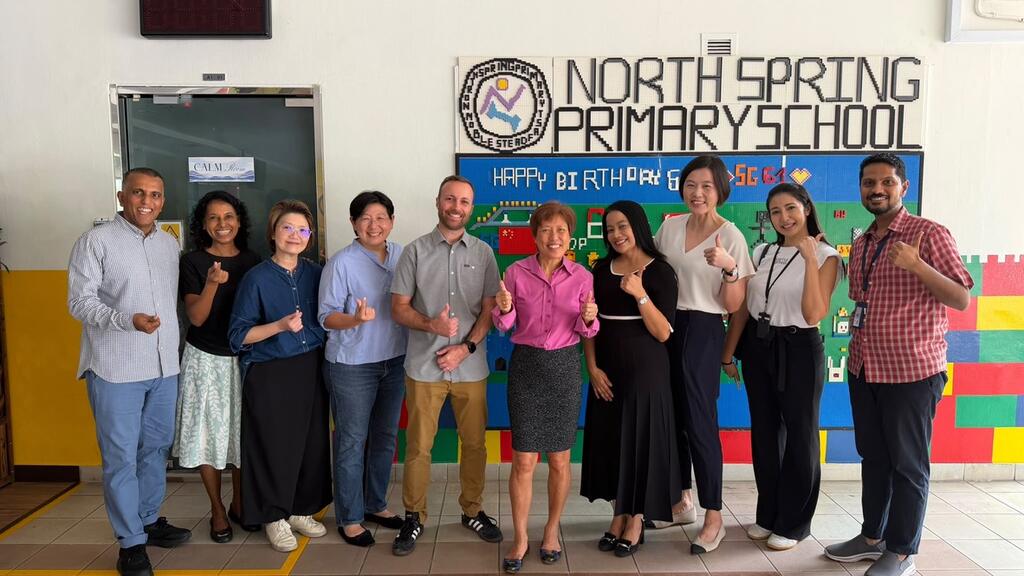
Photo courtesy of Tim Patterson