
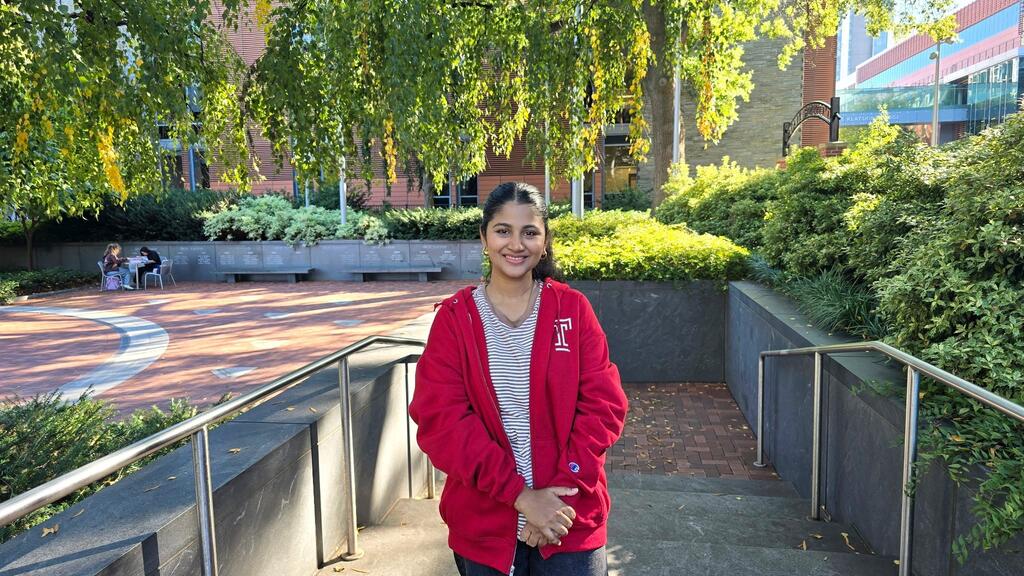
Photo courtesy of Sanjida Akter Tanni
I came to Temple after spending six years as a university faculty member in Bangladesh, but the journey that brought me here began much earlier. My path through education was not always easy or straightforward. Growing up and pursuing higher education in Bangladesh, I learned that ambition sometimes requires persistence, negotiation and the courage to continue even when circumstances make the path difficult. Over the years, I navigated social expectations, marriage, motherhood, academic responsibilities and the challenges of building a career in higher education. I do not think my strength developed because life was easy; it developed gradually through the obstacles, responsibilities and experiences that required me to keep moving forward. From a small-town girl raised in an environment where few expected her to complete her education, I became an educator, pursuing my dreams while breaking many of the stereotypes that can hold women back.
I believe those experiences also shaped the educator I became. My interest in mathematics education grew from seeing how differently people learn and realizing how much the right kind of teaching can change a learner’s relationship with mathematics. As a university faculty member in Bangladesh, I had opportunities to teach and work with preservice and in-service teachers, support students from different backgrounds, and think deeply about how teaching can become more inclusive and responsive to learners. Working in contexts where resources were sometimes limited also taught me to be creative, flexible and attentive to the realities that students and teachers bring with them.
Coming to Temple opened another period of learning for me. I arrived with an identity as an educator, but becoming an international doctoral student required me to grow in entirely new ways. I was learning a new academic culture, navigating language and cultural differences, developing new research skills, and rebuilding a sense of community far from the country where I had spent most of my life. In many ways, I had to become comfortable being a learner again.
My doctoral journey has also unfolded alongside some of the most difficult personal experiences of my life. Since coming to the United States, I have experienced significant family loss and have had to grieve while living far from my relatives and the support system I had always known. Still, I did not stop dreaming or working toward the future I came here to build. These experiences have changed me and, in many ways, made me stronger. During those difficult moments, my Temple University College of Education and Human Development (CEHD) community—my advisor, professors, fellow students, colleagues and friends—became especially important to me. Their care, encouragement and presence helped me move through grief while continuing my academic journey.
Being far from home has taught me that community is not only something we are born into; it is also something we can build. CEHD has gradually become that kind of community for me. Since arriving here, I have made a conscious effort to reach out, ask questions, collaborate, participate even when I feel uncertain, and learn from people whose experiences and perspectives are different from mine. Gradually, Temple began to feel less unfamiliar and more like a place where I belong. Now, when I look at my advisor, Professor Meixia Ding, other faculty members, research collaborators, classmates and friends, I often think, “These are my people.” They are people with whom I can exchange ideas, ask for guidance, share uncertainty and continue growing.
Temple’s CEHD has become an important part of my growth, both academically and personally. What has mattered most to me is being part of a scholarly environment that has not only helped me develop my knowledge of educational research and research methods but also given me opportunities to put that knowledge into practice. The PhD curriculum has helped me build the knowledge and skills I need to move toward making meaningful research contributions.
Equally important has been the openness and support I have experienced from faculty. Through faculty mentorship, collaboration on research projects, conversations with colleagues and opportunities to explore questions that genuinely matter to me, I have gradually become more confident in developing my own scholarly voice. CEHD has also given me space to connect my previous experience as a teacher educator in Bangladesh with new questions about mathematics teacher preparation, technology and how we can better prepare teachers to respond to the different ways students think and learn.
Looking ahead, I hope to continue my career in higher education as a professor, researcher and teacher educator. I want my scholarship to contribute to improving mathematics teacher preparation, particularly by understanding how future teachers can be better prepared to notice, interpret and respond to the diverse ways students think about mathematics. I am especially interested in exploring how emerging technologies, including artificial intelligence, can create meaningful opportunities for teachers to practice these complex aspects of teaching. The progress I have made at CEHD has strengthened my confidence that this is a path I can pursue, supported by the opportunities, mentorship and scholarly community I have found here.
When I think about the person who first arrived at Temple’s CEHD, I can see how much I have changed. I came here carrying the experiences, struggles and lessons that shaped me in Bangladesh, and I am not leaving those parts of myself behind. Instead, I am learning how to bring them into conversation with everything I am experiencing here. I still do not have every part of my future figured out, but I now have a clearer sense of the questions I want to pursue, the educator and scholar I want to become and the kind of academic community in which I hope to continue growing.
---
Editor's Note: Sanjida Akter Tanni is a second year PhD education student in the College of Education and Human Development.